
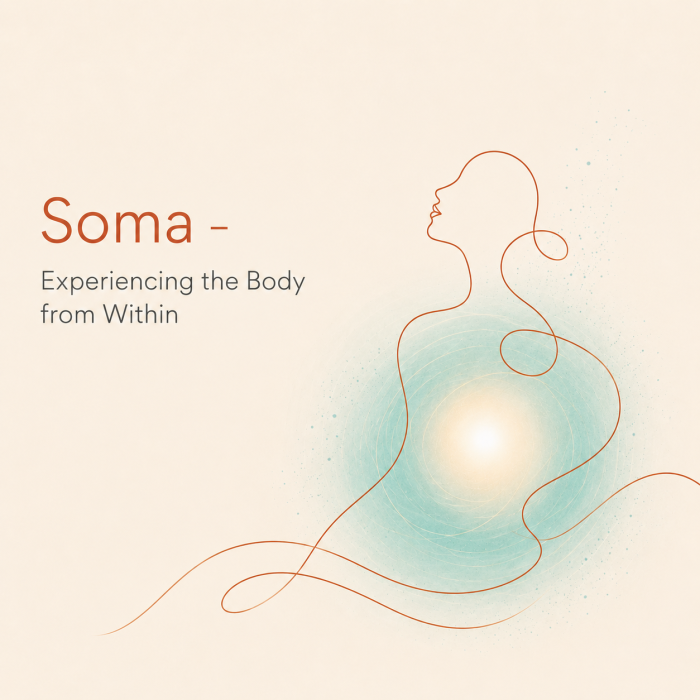
Soma – Experiencing the Body from Within
The word soma comes from the Greek word for “body”, but in somatic practice it has come to mean the living body experienced from within.
This understanding changes the way we approach transformation and wellbeing.
Somatic work isn’t really about “calming down” or “managing stress” in the way we usually use those phrases. It’s about making contact with something that already knows more than we’ve consciously registered — and giving it room to speak.
“Your body is not a machine, rather a wonderfully intricate interaction with everything around you, which is why it “knows” so much just in being…
The living body is always going beyond what evolution, culture and language have already built. The body is always sketching and probing a few steps further.”
— Eugene Gendlin, Founder of Focusing
In Focusing, the body is understood as an all-encompassing living process – the felt body, or how you experience yourself from within. The felt body is a continuous stream of living interactions rather than a static anatomical form, a sealed container ending at the skin. The body is part of a vastly larger system, an ongoing interaction with its environment, capable of holding a vast amount of information about the situations we live in.
In practice, this means your body isn’t just reacting to your life. It’s already in your life — your relationships, your history, the unspoken dynamics in a room, in a way your conscious mind hasn’t caught up to yet. We live every situation through the body not only through obvious emotions such as happiness, sadness, or fear, but through a complex bodily sensing of the whole situation.
The body is not a thing but a dynamic process of interacting with the world. Its vast, living intelligence contains the “felt sense” – an implicit, physically experienced knowing that holds the entirety of our lived situations.
Seeing the body in this way allows us to access its deeper wisdom. As we learn to listen to the felt sense, the body often responds with what Gendlin called a felt shift – a subtle but unmistakable bodily sense that something has moved, opened, or become clearer. The felt shift is physical.
This felt shift lies at the heart of Focusing and forms one of the foundations of the Inner Connexion Method.
Rather than trying to change ourselves through effort or analysis, we learn to listen differently. And as the relationship with our inner experience changes, the relationship we have with ourselves begins to change.